WHAT DO YOU NEED?
Transfer
-
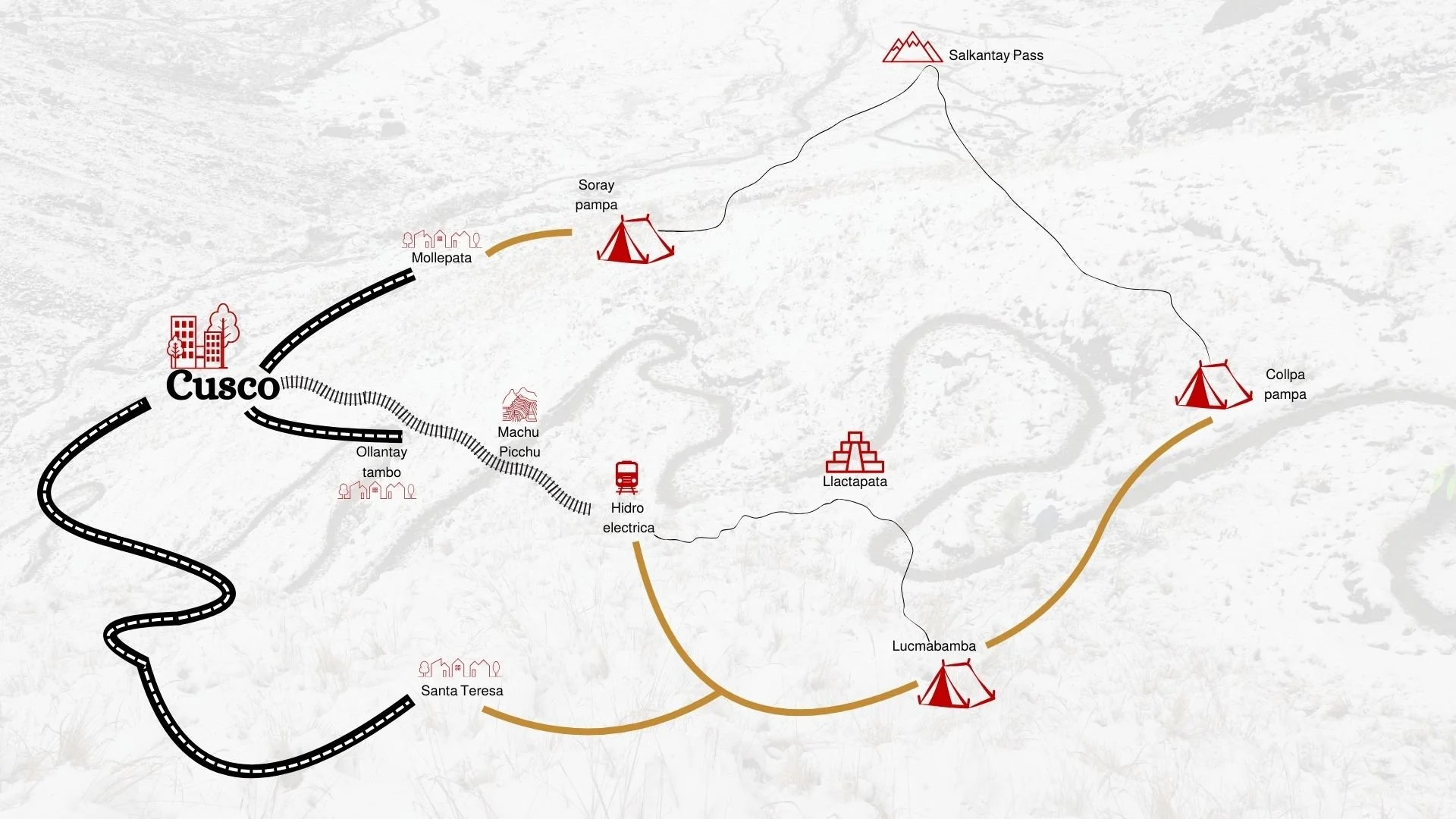
Colectivo (shared van) Cusco to Mollepata.
They start from 4am
From S/. 25 to S/. 35 soles (per person)
Taxi colectivo (Shared taxis) Mollepata to Soraypampa.
They live from the plaza of Mollepata: https://maps.app.goo.gl/sKwfLQzK2PHUMQmj7
From s/40 to s/50 soles (per person)
Private Van:
Pick up from accommodation.
You set the pick up time.
For 2 - 3 people s/. 250.
For 3 - 6 people s/. 380.
For 6 to 12 people s/. 480
For 12 to 18 people s/. 520
-
Colectivo (Shared van) From Collpapampa to Playa Sawayaco or Lucmabamba:
Location: In front of our lodge.
From S/. 30 (per person).
They start at 7am.
Private Taxi:
Pick up from our lodge.
You set the pick up time.
For 2 - 3 people s/. 150.
For 3 - 6 people s/. 250.
For 6 to 12 people s/. 350
For 12 to 18 people s/. 400
-
Private taxi only.
Pick up from your lodge
For 2 - 3 people s/. 220
For 4 - 6 people s/. 280
For 7 - 12 people s/. 320
For 13- 18 people s/. 370
-
Private taxi only.
(Round trip + s/. 80 in every price below)
From Collpapampa to Cocalmayo hot springs.
Pick up time from 6am to 8am.
For 2 to 3 people s/. 200
For 4 to 6 people s/. 320
For 7 to 12 people s/. 370
For 13 to 18 people s/. 420
From Lucmabamba to Cocalmayo.
Pick up in the mornings and afternoons
For 2 - 3 people s/. 150
For 4 - 6 people s/. 230
For 7 - 12 people s/. 280
From 13 - 18 people s/. 320
WHAT TO PACK LIST
-
The most critical gear for surviving the nights at Soraypampa (3,900m) where temperatures often drop below freezing.
The Tent: A lightweight 3-season tent is sufficient, but it must have a rainfly. Afternoon storms are common.
Sleeping Bag: You need a bag with a comfort rating of -5°C to -10°C (15°F). Down bags are lighter and pack smaller than synthetic ones.
Rental Note: If you don't own one, rent a high-quality down bag in Cusco (shops like Rosly or Speedy Gonzales near the Plaza de Armas).
Sleeping Pad: The ground sucks the heat out of you faster than the air does. Use an inflatable pad with an R-value of 3.0 or higher. A simple foam yoga mat is not enough for the first night.
-
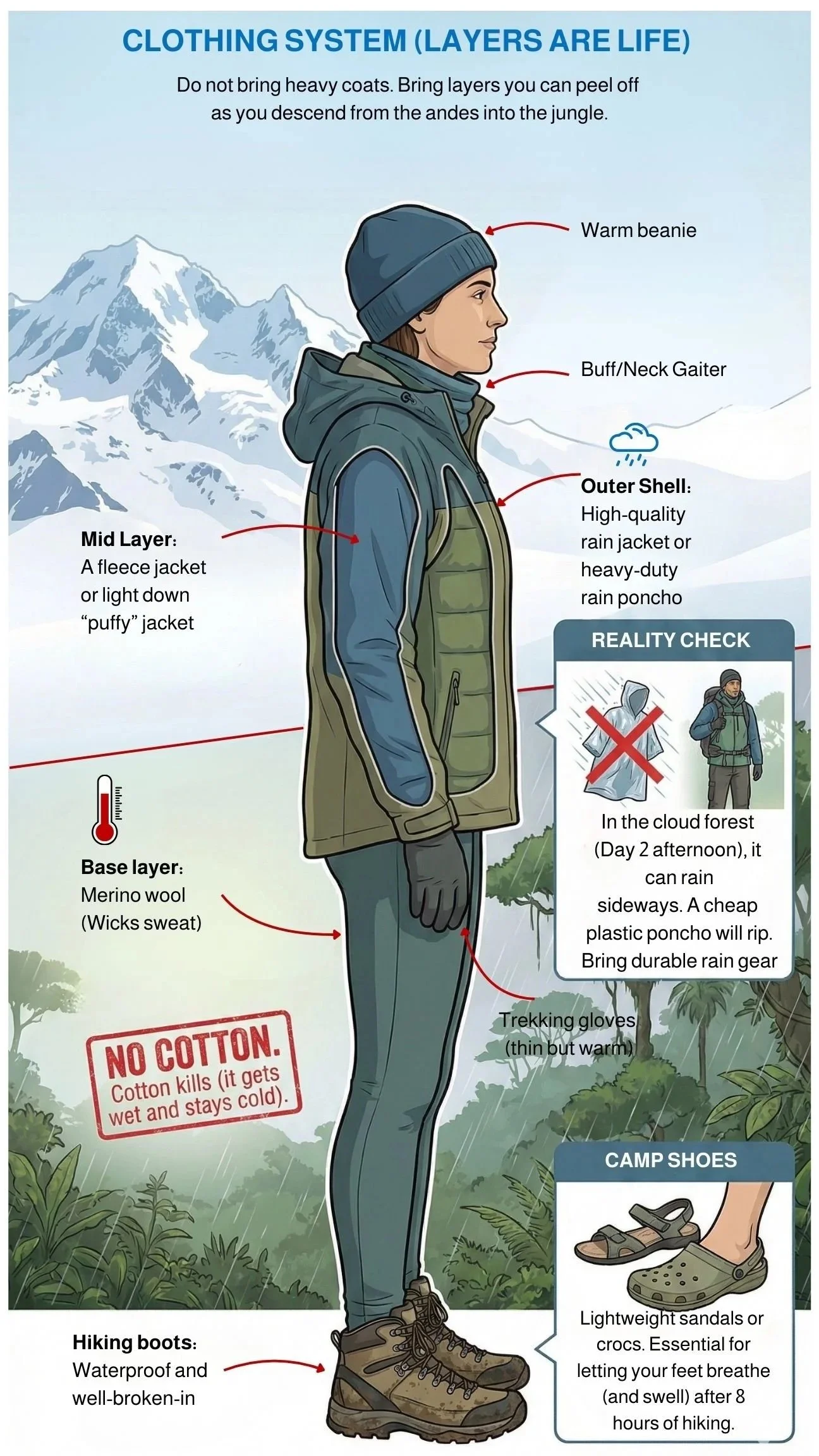
Do not bring heavy coats. Bring layers you can peel off as you descend from the Andes into the Jungle.
Base Layer: Merino wool or synthetic top and bottom. NO COTTON. Cotton kills (it gets wet and stays cold).
Mid Layer: A fleece jacket or light down "puffy" jacket.
Outer Shell: A high-quality rain jacket or a heavy-duty rain poncho.
Reality Check: In the Cloud Forest (Day 2 afternoon), it can rain sideways. A cheap plastic poncho will rip. Bring durable rain gear.
Footwear:
Hiking Boots: Waterproof and well-broken-in.
Camp Shoes: Lightweight sandals or Crocs. Essential for letting your feet breathe (and swell) after 8 hours of hiking.
Accessories: Warm beanie, trekking gloves (thin but warm), and a buff/neck gaiter (great for dust on the trail).
-
Solo hikers often underestimate how much fuel they need.
Water Filtration: You will pass many streams, but cattle graze nearby. Do not drink untreated water.
Best option: Squeeze filters (like Sawyer) or UV purifiers (Steripen).
Backup: Chlorine dioxide tablets (Micropur).
Electrolyte Powder: Water alone isn't enough when you sweat for 8 hours. Bring powdered Gatorade or "Oral Rehydration Salts" (Suero Oral) from a pharmacy. It prevents headaches and leg cramps.
The Strategy: High Calories, Low Weight, No Crush.
Rule #1: If it can get squashed (like a banana or a croissant), it will turn to mush in your pack.
Rule #2: You will burn 3,000+ calories a day. Dieting is forbidden on Salkantay.
Rule #3: Sugar is good for altitude. It gives your brain quick oxygen.
1. The "Pocket Snacks" (Eat while walking)
Keep these accessible in your hip-belt pockets.
Peruvian Chocolate (Sublime/Princesa): You are in the land of cacao. A "Sublime" bar is cheap, high-calorie, and a huge morale booster when you are tired on the pass.
Coca Candies (Caramelos de Coca): Help with altitude sickness and dry mouth. Buy a big bag in Cusco.
Nuts & Dried Fruit (Frutos Secos): Buy these in bulk at the San Pedro Market in Cusco. Almonds, walnuts, and raisins provide slow-burning energy.
Energy Bars: Bring your favorites from home (Clif/RxBars) or buy local granola bars (barras energéticas) in Cusco supermarkets.
-
Buy in Cusco: Specialty items (Energy bars, Tortillas, Tuna pouches, Electrolytes).
Buy on the Trail (Mollepata/Soraypampa): Water, basic cookies (Oreos), occasional fruit (apples/oranges).
Buy in the Jungle (Your Area - Collpapampa/Lucmabamba):
Passion Fruit (Granadilla): The perfect hydration snack.
Avocados (Palta): They grow wild here! Buy one from a local stand for lunch.
Bananas: Only buy them if you eat them immediately
-
You are your own medic on the trail.
WE HIGHLY RECOMMEND TO CONSULT WITH YOUR DOCTOR BEFORE. !!
Blister Care: "Leukotape" (zinc oxide tape) is superior to Moleskin. Tape your "hot spots" before they become blisters.
Altitude Meds:Acetazolamide (Sorojchi Pills) can help, but consult your doctor. Coca leaves (buy in Cusco markets) are the local remedy—chew them or put them in tea.
Stomach Issues: Loperamide (Imodium) and Ciprofloxacin (for severe infection - consult a doctor).
Sun Protection: The UV radiation at 4,000m is extreme. SPF 50+ sunscreen, lip balm, and sunglasses are non-negotiable.
-
Power Bank: 10,000mAh to 20,000mAh. Cold batteries die fast. Keep your phone and batteries inside your sleeping bag at night to preserve charge.
Headlamp: Essential for the 4:00 AM start on Day 2 and for navigating campsites. Bring spare batteries.
Offline Maps: Download the Cusco region on Maps.me or Google Maps before you leave Wi-Fi. The trail is obvious, but fog can obscure it.
-
Toilet Paper: Carry your own. It is rarely provided at campsites.
Ziploc Bags: For packing out your trash (Leave No Trace) and keeping electronics dry.
Cash (Soles): Small bills (10s and 20s). Rural shops and campsites often cannot break a 100 Sol note.
💡 LIGHTEN YOUR LOAD Staying in local lodges?
You can leave the heavy camping gear and food supplies behind. Most family-run lodges on the trail offer a warm bed, hot breakfast, and a nutritious Box Lunch for your journey. This simple choice drastically reduces your backpack weight, allowing you to save your energy for the climb.
HOW DO I GET MACHUPICCHU TICKETS
-
There is only one official government website for Machu Picchu tickets. Do not use "reseller" sites that charge double the price.
You also can find more information about the different circuits and image references and more updated information.
To Book in Advance (Recommended):tuboleto.cultura.pe
This is the direct government portal. It accepts major credit cards and lets you book months ahead.
-
🏆 The Best Option: Circuit 2 (Classic Route)
Why: This is the "Postcard" ticket. It includes the famous view from the top (Guardian’s House) and a full walk through the ruins (temples, plazas).
Route A or B? Both are great. They are nearly identical.
Difficulty: Moderate. Lots of stairs.
📸 The "View Only" Option: Circuit 1 (Panoramic)
Why: Good if Circuit 2 is sold out. You get the famous photo from the upper terraces, but you cannot go down into the stone city. You stay on the upper perimeter.
Includes: Entrance to "Machu Picchu Mountain" (The huge mountain, not the ruins) if you select that add-on.
⛰️ The "Adventure" Option: Circuit 3 (Royalty + Huayna Picchu)
Why: This is the only ticket that lets you climb Huayna Picchu (the steep sugarloaf mountain behind the ruins).
The Catch: You do NOT get the classic upper view of Machu Picchu. You enter from the bottom.
-
Did you arrive in Cusco with NO ticket? Don't panic.
The Ministry of Culture releases 1,000 tickets per day for in-person purchase in Aguas Calientes (Machu Picchu Pueblo).
https://maps.app.goo.gl/FtAzDYoHEskYw8CE6
How to get one:
Arrive Early: You must be in Aguas Calientes the day before you want to visit.
The Queue: Go to the "Ministry of Culture" office (near the main plaza) find the queue next to the door and once inside get the tickets if available for the next day or the day after.
Bring: Your physical Passport (no photos).
Payment: Cash (Soles) or Credit Card. Note: You usually have to settle for whatever circuit is left (often Circuit 3), but you will get in.
To Check Last-Minute Availability: Check the "1,000 Tickets" Status Here
Heading to Aguas Calientes without a ticket? Use this specific link to see how many "in-person" tickets are left for the next few days before you make the journey.
The Golden Rule
⚠️ BOOK BEFORE YOU ARRIVE IN PERU. Machu Picchu tickets sell out 2–3 months in advance during the dry season (May–October). Do not wait until you get to Cusco.